
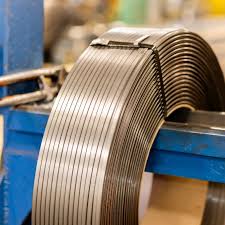

Oscillated wound coils (also known as “traverse wound” or “helical” coils) are a game-changer for high-volume Midwest manufacturing. While a standard “ribbon” wound coil looks like a roll of tape, an oscillated coil looks more like a massive spool of thread.
For a flat steel purchaser, moving from ribbon wound to oscillated wound is less about the metallurgy of the steel and more about operational efficiency and supply chain optimization.
What is an Oscillate Wound Coil?
In a standard Ribbon Wound Coil, each wrap of steel is layered directly on top of the previous one. This limits the total footage of the coil to the physical outside diameter (OD) of that single-width stack.
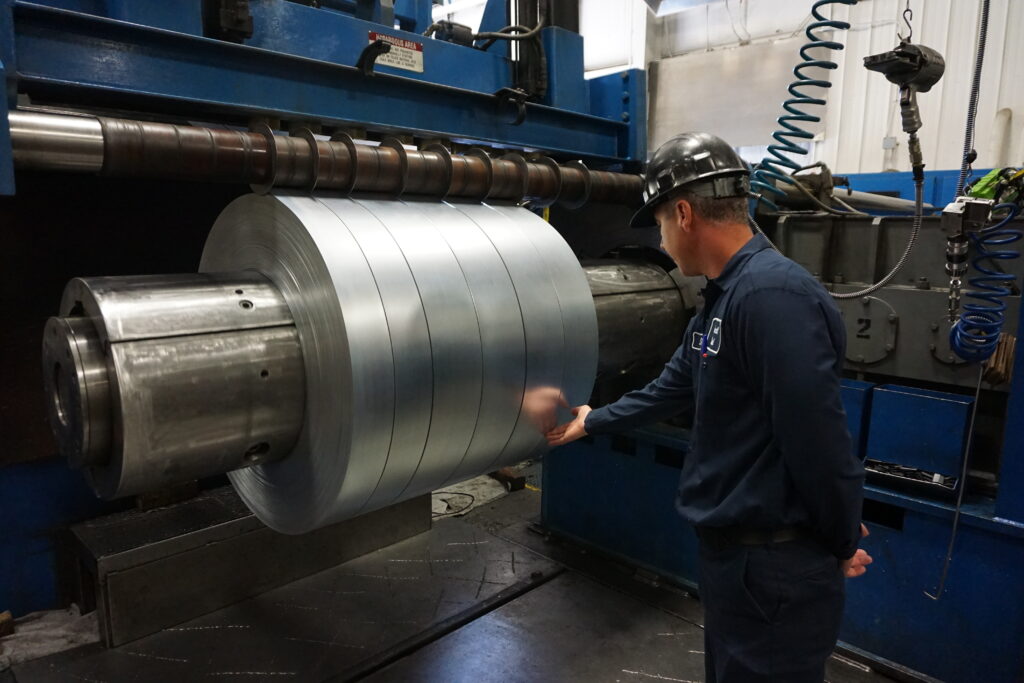
In an Oscillate Wound Coil, the slit strip is moved back and forth across a wider face (the arbor) during the winding process. This allows you to fit significantly more linear footage (sometimes 10 to 15 times more) onto a single spool without increasing the OD to a size outside of your machine’s capacity.
Material Implications for the Purchaser
When you are purchasing for an oscillate-dependent line, there are three technical factors to keep in mind:
- Reduced Coil Set and Camber: Because the material is wound across a wider surface, the internal stresses are distributed differently. This often results in a flatter, more consistent feed into the stamping or roll-forming press.
- The “Weld” Factor: To create these massive spools, smaller coils are often butt-welded together. As a purchaser, you must specify with your service center how many welds per coil are acceptable and if those welds need to be marked (usually with paint) so your press sensors can skip them.
- Edge Conditioning: Oscillating is often paired with edge rolling or de-burring. Since these coils are meant for long, uninterrupted runs, having a “safety edge” or a perfectly square edge reduces friction in the feed guides and prevents die wear.
Why This Matters for Midwest Manufacturing
The Midwest is the heart of high-speed stamping, automotive component production, and appliance manufacturing. In these environments, uptime is the only metric that matters.
1. Drastic Reduction in Downtime
In a typical 8-hour shift, a press operator using ribbon coils might have to stop the line 10 times to change a coil. Each changeover involves:
- Locking out the machine.
- Removing the core.
- Loading the new coil.
- Threading the lead.
- Re-adjusting the straightener.
With oscillate wound coils, that same operator might only change the coil once or twice per shift. This can increase total daily output by 20% or more without changing the press speed.
2. Tooling and Die Longevity
Midwest shops often run complex progressive dies. Stopping and starting a press creates “short-hit” scrap and can cause inconsistent lubrication on the die. Continuous feeding from an oscillate spool keeps the die at a consistent temperature and pressure, extending the time between sharpenings.
3. Freight and Storage Efficiency
Because oscillate coils are wider and more stable, they can often be stacked more efficiently in a warehouse. For a purchaser, this means fewer “set-up” charges from the service center and more pounds of steel per square foot of floor space.
Applications
If you are purchasing for these industries, oscillate wound steel should be on your radar:
- Automotive Clips and Fasteners: Small, high-volume parts that run on high-speed “Minster” or “Bruderer” style presses.
- HVAC Components: Strap hangers, duct brackets, and connectors.
- Appliance Hardware: Hinges, brackets, and internal structural supports for “white goods.”
- Furniture Hardware: Drawer slides and mounting brackets.
The Bottom Line: Oscillate wound coils turn a steel commodity into a productivity tool. While the price per pound might carry a slight premium due to the extra processing at the service center, the “total cost of ownership” is lower due to reduced labor, less scrap, and maximized machine uptime.
Contact us today so that we can create a custom quote for your unique needs!